




Analog and digital systems work quite differently but modern CCTV networks use conversion software and hardware to convert analog to digital. This process is called retrofitting.
A traditional CCTV system comprises:
● One or more cameras (analog or digital), each with a lens equipped with an image sensor
● A recorder – Either a standard video tape recorder for analog systems, or a Direct Video Recorder (DVR) or Network Video Recorder (NVR) for digital systems
● Cables – Either RJ45 for digital or coaxial for analog
● One or more monitors to which the images are transmitted
1. A camera records images through the lens using image sensors.
2. These images (and often audio too) are transmitted to the recorder or tape, either wirelessly or by cable. Recorders may use analytical software and other smart technologies to scan the data and send automated alerts to either humans, or other systems and devices. This Video Management Software (VMS) records, stores and analyzes video feeds. The software is often self-learning, using machine learning (ML) algorithms that utilize functionality like motion detection, face recognition, people counting, etc.
3. Monitor(s) can be passively (through software) or actively (by people) monitored. CCTV networks can, and should, themselves be monitored.
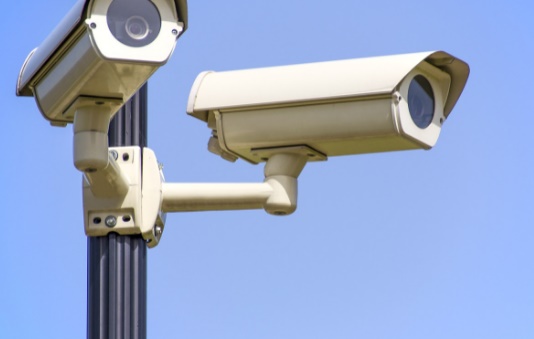
Analog – Use Bayonet Neill-Concelman (BNC) connectors on coaxial cables to transmit continuous video signals. They are relatively low resolution but cheap and effective. There are more peripherals in an analog system, e.g. standard coaxial cables don’t usually transmit audio. Analog signals can be digitized, making it more cost-effective to go digital even with older equipment. The images require a video capture card and can be stored on a PC or tape recorder. A step up, analog HD enables increased resolution over traditional systems (1080 pixels) and are backwards compatible with analog cameras and BNC.
● Digital – Digitalize signals at camera level. These systems don’t require a video capture card as images are stored directly to a computer but require a (relatively) large amount of space to store recordings, so they are usually heavily compressed.
● Network or IP – Used with analog or digital cameras, these systems utilize a video server to stream footage over the internet. The advantages are the possibility of WiFi and audio, Distributed Artificial Intelligence (DAI) for analyzing image footage, remote access, Power Over Ethernet (POE), and better resolution. Furthermore, IP cameras have the ability to contain more cameras in one, which can cover a wide angle that may normally take multiple cameras or camera systems to cover.
All three options are still equally in use, with a high tendency to IP camera systems and digital video cameras.
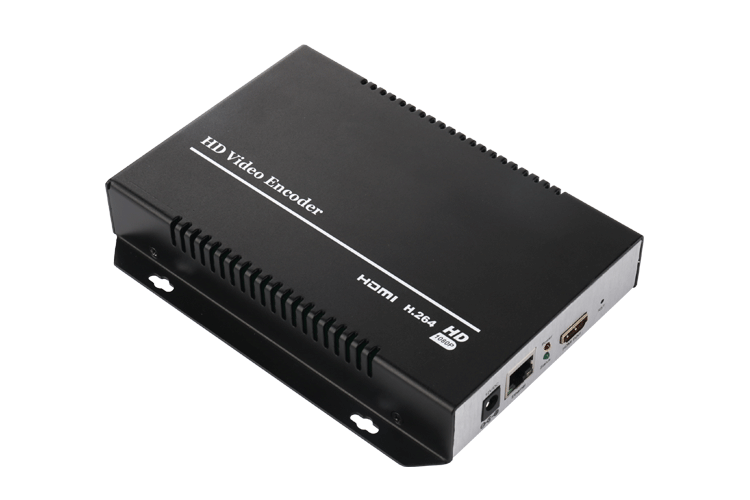
Video encoders allows for the migration of analog CCTV systems to some network systems, enabling users to take advantage of cheaper hardware and modern features. The software allows a wired connection and then digitalizes video signals, sending them to a wired or wireless IP-based system.
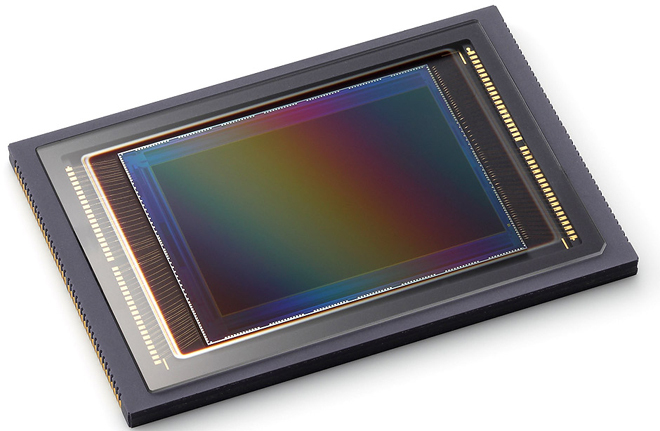
Cameras use different types of image sensors, which convert light into electronic signals. A sensor comprises multiple photodiodes, or pixels, which register the amount of exposed light and converts it to electrons. The two most popular formats are CMOS (complementary metal oxide semiconductor) and CCD (charged coupled device).
● CMOS – These are more cost-effective than CCD sensors. Megapixel (utilizing millions of pixels) CMOS sensors may even rival the quality of CCD sensors.
● CCD – These are more costly with a higher power consumption. CCD scanners are generally the best option for inclement light conditions (they have higher light sensitivity) and they are quieter than CMOS. (While the signal itself is analog, it is converted for transmission by an analog-to-digital converter, which turns the pixels’ values into numeric values.)